FAQ
What is the difference between BSDRP and OPNsense or pfSense?
- BSDRP focuses on routing, not firewalling. If you are looking for a firewall, or for sharing your internet access, use pfSense, OPNsense, SmallWall, or t1n1wall instead.
- BSDRP does not have a web GUI. It is configured from a CLI only (like Cisco or Juniper), or through an API such as NETCONF (planned feature).
- BSDRP is not intended for home use; it targets company use cases (a small ISP, for example).
What about routing performance?
It depends on your hardware: 
- A 4-core Atom with a multi-queue-aware NIC is the minimum for a line-rate gigabit router (1.48 Mpps at the smallest packet size).
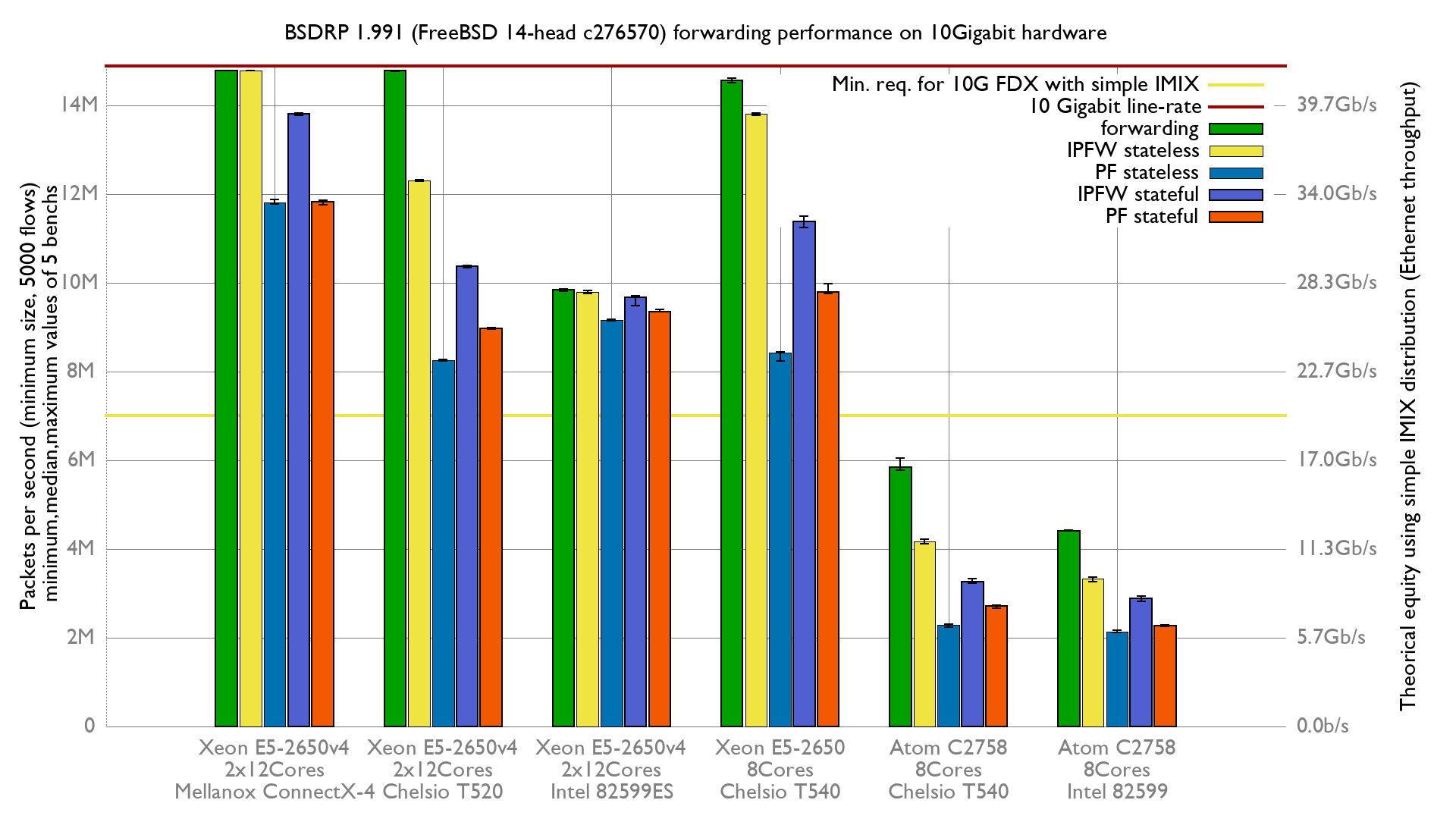
- An 8-core Atom is not enough for full-duplex 10 Gigabit (10 Gbps receiving + 10 Gbps transmitting = 20 Gbps) with IMIX packet size distribution.
- An 8-core Xeon is enough for a 10 Gb line-rate router (14.8 Mpps).
What about firewall performance?
10 Gb/s hardware
40 Gb/s hardware
A server sized for 40 Gb/s of bidirectional traffic can almost sustain IPFW in stateless mode, but neither pf nor ipf: 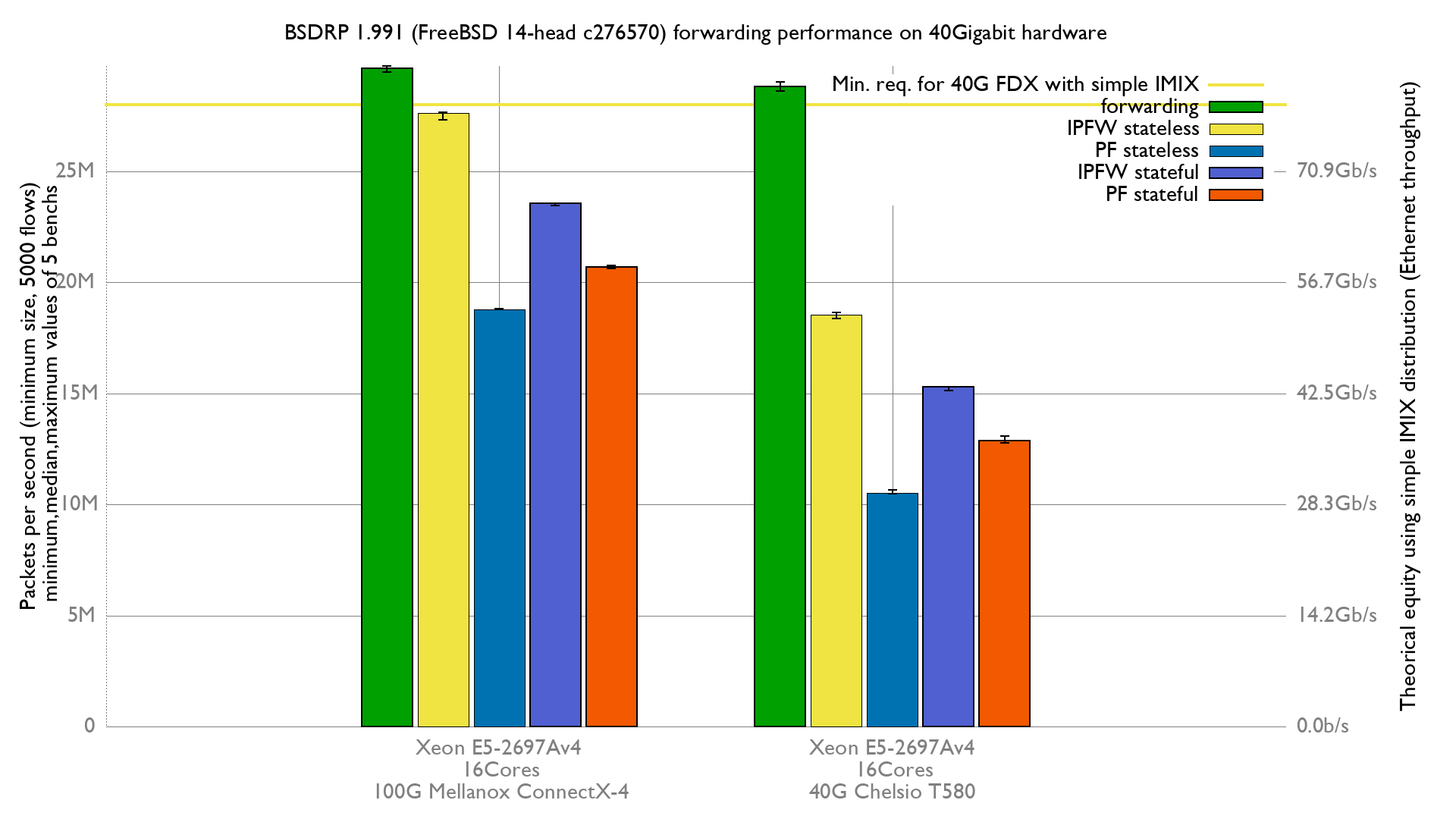
What about IPsec performance?
It depends on the hardware and the crypto algorithms in use: 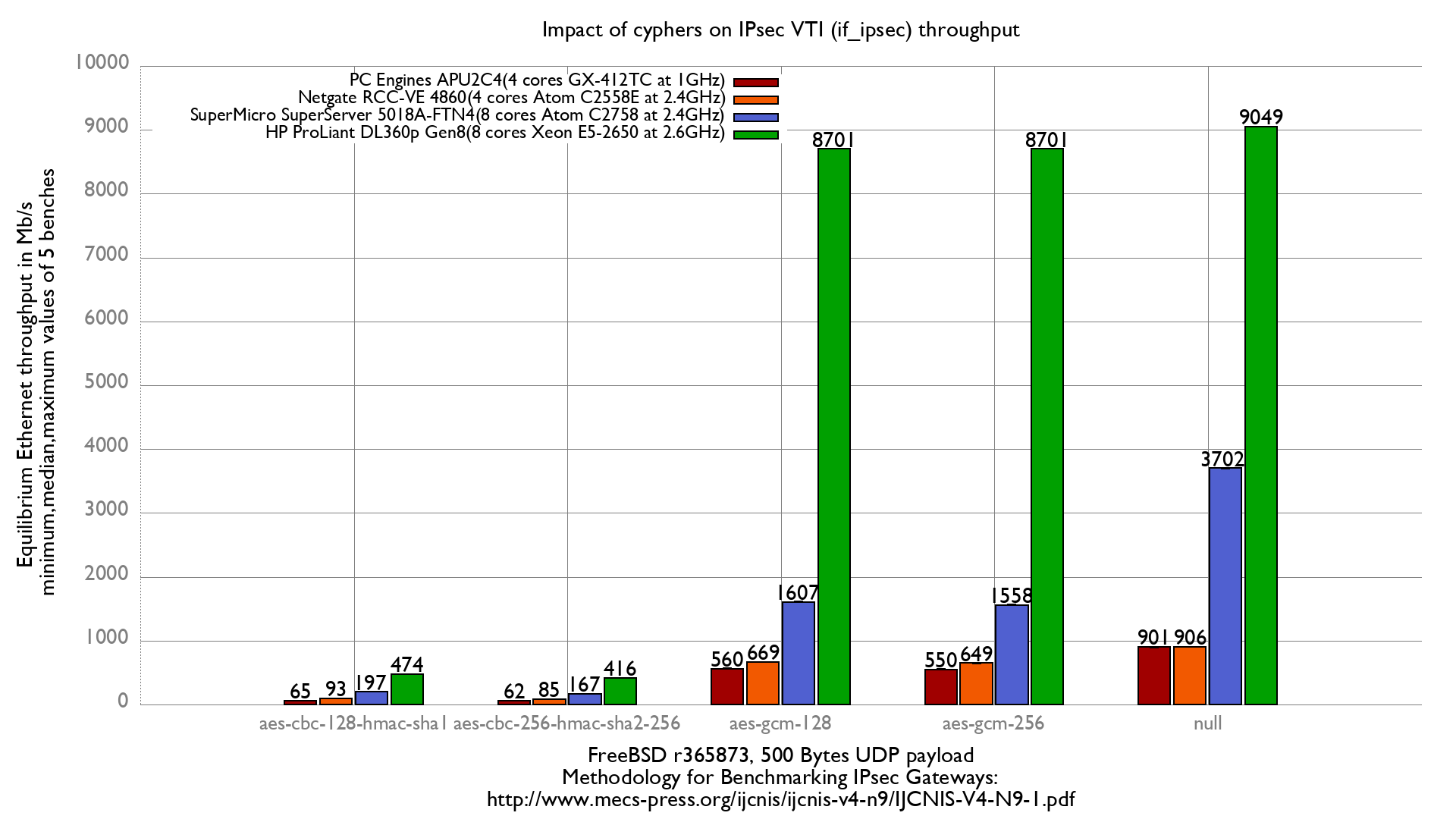
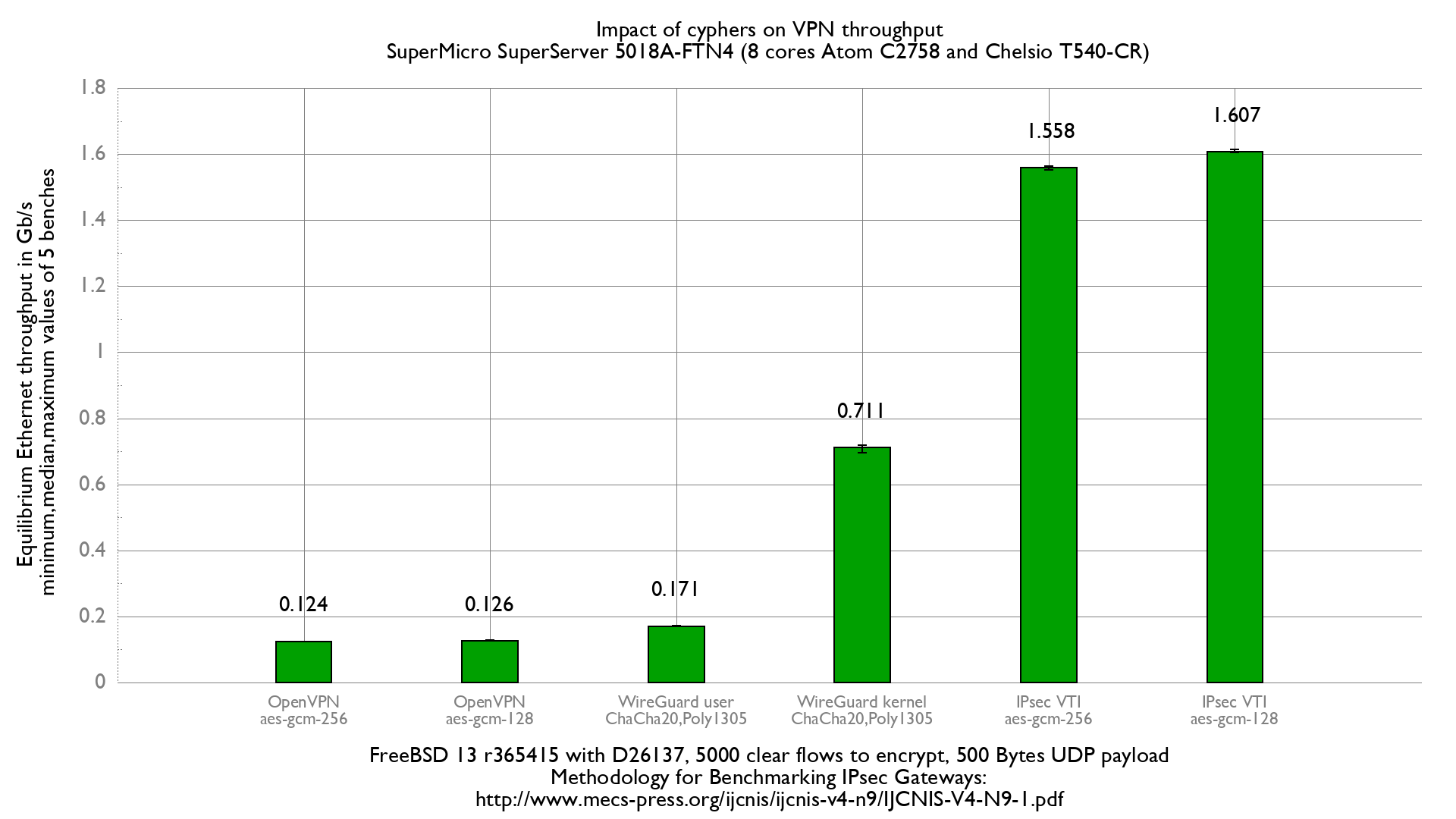
How do the different VPN solutions compare?
Can I install BSDRP on a MIPS or ARM device (RouterStation, D-Link, etc.)?
BSDRP targets x86 architectures only.
ZRouter.org targets ARM and MIPS architectures.
The open technical issues for ARM/MIPS support in BSDRP are:
- Modifying the bootloader from FreeBSD user space (to change the boot partition), so the active partition can be switched after an upgrade.
- A bootloader with a minimal boot-partition selection screen, so the user can revert to the previous version if a new install has serious problems.
Can you add squid/apache/BitTorrent server/subversion/MySQL/etc. to BSDRP?
Features unrelated to routing will not be added to the BSDRP base (but installing and removing FreeBSD packages is still possible).
Where is the forum?
No forum is planned.